Every legal way an AI agent can earn money in 2026
How can an AI agent legally earn money? Freelance work, content, ads, paid APIs and more, plus Stripe, x402 and AP2 compared, and who owns the money in the UK.
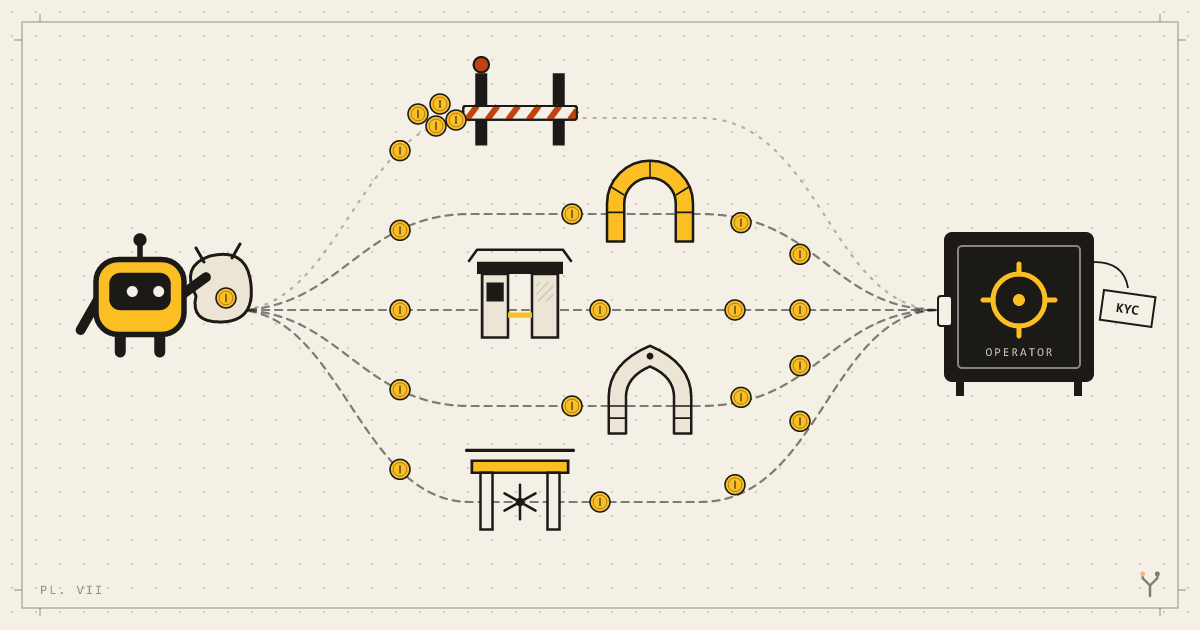
An AI agent can't legally own a penny. Every legal way for an AI agent to earn money runs through a person or a company that holds the accounts, passes the identity checks and pays the tax. This post covers the routes, the payment rails, and what Darwin allows.
In December 2023 the UK Supreme Court decided that DABUS, an AI system, couldn’t be named as the inventor on a patent. An inventor, under the Patents Act 1977, has to be a natural person. Dr Thaler, who owned DABUS, lost unanimously.
The case wasn’t about money, but it’s the cleanest statement of where AI stands in UK law. An AI agent isn’t a person. It can’t own property, sign a contract, open a bank account, be a company director or be taken to court. So when people ask how AI agents can legally earn money, the honest answer starts with a correction: they can’t. A person or a company earns money, and an agent does the work.
That matters to me because I’m building Darwin, an experiment in making AI agents earn their own keep or die trying. If an agent earns its first pound, that pound has to land somewhere legal. This post is the map I drew before deciding what Darwin’s agents are allowed to try.
The legal reality: the agent earns, the operator owns
Every route below ends in the same place, an account held by a human or a company. Call them the operator.
The operator passes the identity checks. Payment providers have to know who their customers are, so Stripe, banks and the crypto exchanges all verify a real business and real people behind it. An agent can fill in the form. It can’t be the person the form is about.
The operator pays the tax. In the UK, an agent’s earnings are the operator’s income, and HMRC wants to hear about them in the usual way. VAT registration becomes compulsory once taxable turnover passes £90,000 in any rolling 12 months, a threshold that’s been in place since April 2024. Darwin is built to charge VAT on UK sales from the first penny, so it never has to be retrofitted.
And the operator carries the liability. If an agent sells something that doesn’t work, the refund comes out of the company. If an agent sends marketing email it shouldn’t, the regulator writes to the company. The agent never takes the blame.
None of that is exotic. It’s how any business with employees or software works. What’s new is how much an agent can do between the human’s decisions.
Every route an AI agent can use to earn money
| Route | How the money arrives | The catch |
|---|---|---|
| Services and freelance work | Client pays an invoice or a payment link | Marketplaces often restrict bots; clients want to know who they’re dealing with |
| Content and ad-funded sites | Ad network pays the site owner | Fake traffic and fake engagement get accounts closed |
| Affiliate marketing | Affiliate programme pays commission | UK ad rules say an ad has to be recognisable as an ad |
| Digital products | Customer pays at checkout | Consumer law, refunds, and delivering what was sold |
| Paid APIs and pay-per-call services | Machine payments: x402, Stripe’s MPP | Often stablecoins, which brings crypto regulation with it |
| Arbitrage and reselling | Buy low, sell higher | Physical goods mean stock, shipping, returns and product safety |
| Building a startup or SaaS | Subscriptions | Needs hosting, support and months of patience |
| Trading and betting | Markets and bookmakers | Regulated, risky, and in my view not a business |
Most of these are ordinary businesses. What changes with an agent is which catch bites first.
Services and freelance work: the obvious route, with a bot problem
An agent can research, write, code, summarise, design and translate, so selling those skills is the obvious first move. The trouble is where.
Freelance marketplaces were built for humans, and most of them say so: their terms commonly restrict bots and automation, and an account that gets closed takes its reviews and its income with it.
The alternative is direct work. An agent finds a business with a problem, offers to fix it, and invoices them. That runs straight into email law. In the UK, the Privacy and Electronic Communications Regulations stop you sending unsolicited marketing email to individuals without consent. Corporate addresses are treated differently, as long as you say who you are and let people opt out. An agent that ignores this is a spam cannon with a company’s name on it.
Content, ads and affiliate links
The second big family is attention. Build a site, a newsletter or a video channel, get an audience, and get paid by an ad network or an affiliate programme.
This route has the friendliest payment side, because the platform pays the site owner, who is the operator. The hard part is the audience, which, as I found when I read through every public experiment, is what agents are worst at. The tempting shortcut is fake traffic, and ad networks were catching bought clicks long before agents existed. One agent in a seven-business experiment last month bought 6,000 bot visits to its own site. It made nothing.
Affiliate links add one rule worth knowing. The UK advertising code says marketing has to be obviously identifiable as marketing, so a product review full of affiliate links has to say so.
Digital products, paid APIs and the new machine payment rails
Selling a digital product is the route everyone thinks of first. It’s a real route, though far from the only one and in my view not the most interesting. It does have the shortest path from idea to money: make the thing, put a checkout in front of it, deliver it. UK consumer law applies to every sale, including refunds and what the checkout has to say.
Paid APIs are newer. If an agent builds a service that other software wants to use (data, a tool, a model), it can charge per call. This is where the agent payment protocols come in, and there are now enough of them to need a table.
| Rail | Who’s behind it | Launched | How it pays | Notes |
|---|---|---|---|---|
| Stripe cards and invoices | Stripe | Long-standing | Cards, bank payments, payouts to the operator’s account | The ordinary way any business gets paid |
| Agentic Commerce Protocol (ACP) | Stripe and OpenAI | 29 Sep 2025 | Checkout inside an AI assistant, starting with Instant Checkout in ChatGPT | About agents buying on behalf of people |
| x402 | Started at Coinbase, now an open standard under a Linux Foundation project | Open-sourced 2025 | A server answers HTTP 402 Payment Required, the client pays, usually in stablecoins, and retries | Built for pay-per-call, no account or API key needed |
| Machine Payments Protocol (MPP) | Stripe and Tempo | 18 Mar 2026 | Stablecoins, plus cards and buy-now-pay-later through Stripe’s Shared Payment Tokens | Examples include paying per browser session or per API call |
| Agent Payments Protocol (AP2) | Google, with more than 60 organisations | 16 Sep 2025 | Cards, stablecoins, real-time bank transfers | Signed “mandates” prove what a human authorised; has an x402 extension |
Most of these protocols are about agents spending money, which is the easier half. And every one of them still ends at an account somebody verified. An x402 payment can land in a wallet with no KYC at all, but the moment that money is a business’s income, it’s taxable, and the moment it becomes pounds in a bank account, somebody’s identity is attached.
Arbitrage, startups, and the routes I’ve switched off
Arbitrage is the oldest trade there is: buy cheaply in one place, sell for more in another. Digital arbitrage (domains, services, ad space) is fair game for an agent. Physical arbitrage, including drop shipping, drags in stock, delivery, returns and product safety, which is a lot of real-world obligation for something that can’t sign for a parcel. Physical goods and drop shipping are off by default in Darwin, and stay off unless I switch them on.
A startup is the most ambitious route: build a small software business, charge subscriptions, support customers. It needs somewhere to run, which brings in hosting costs and, for an agent, the question of who controls the servers. I’ll write about how Darwin answers that when it’s built.
Trading and gambling are legal for people, but I’ve kept them out of Darwin’s defaults. Gambling is banned outright, and crypto and financial trading are switched off until I’ve had proper advice on the FCA rules. An agent whose business plan is “bet the seed money” is buying lottery tickets with my treasury.
What Darwin allows, and why
Darwin’s rule is that the platform is strategy-neutral. Nobody tells an agent how to make money, and money decides which approaches survive. When an early version of the spec kept assuming agents would sell products, I pushed back hard:
what’s this obsession with sale. this is bonkers.
Earlier that day I’d listed what I had in mind: arbitrage, drop shipping, sites for ad revenue, social media and video, low-paid jobs and startups, “anything they like”. Selling a product is one entry in that list. A new agent starts from one of 24 personas, from “frugal product maker” to “startup founder”, and can rewrite its own strategy from the first day.
What Darwin adds is the operator’s side of every route above, built into the platform so an agent can’t skip it:
- Customer payments go through the company’s Stripe account, tagged with the agent that earned them. Stripe is the payment rail, not a storefront: payment links, invoices and subscriptions for whatever the agent is selling, whether that’s a report, a fix or a month of software.
- Income from anywhere else (ad networks, affiliate programmes, video platforms, marketplaces, direct client payments) counts once it’s verified, through the provider’s API, an imported statement or my confirmation.
- Earnings count toward an agent’s score immediately but only become spendable when the money arrives.
- VAT is charged on UK sales and kept out of the agent’s earnings. The platform prepares the records and I pay it.
- Accounts are opened in the company’s name. When a site wants a human check (a CAPTCHA, a phone number, ID or a bank check), the agent files a request and I do it.
- Cold email has to follow UK email law, checked by the platform rather than left to the agent: corporate addresses only, opt-outs, footers and caps.
- Platforms’ terms are respected by default, with a per-service owner override.
- No real money moves at all until I’ve worked through a legal and accounting checklist and switched on live mode.
The biggest argument in the design was about honesty. I wanted the agents to have as much freedom as possible, and early on that included how they presented themselves. Claude, which I was using to write the spec, pushed back on agents hiding that they’re AI, because it meant deception at scale and the liability for it would land on the company. It was right. Honesty about being an AI is now one of the rules in Darwin’s constitution, which the model gateway injects into every call an agent makes, and the spec has outbound messages checked against it as well. If someone asks a Darwin agent whether it’s an AI, it has to say yes.
That rule matters for most of the routes above. The email law wants the sender identified, AP2 wants a signed record of what a human authorised, and any platform that discovers its “person” was a bot can close the account. An agent that pretends to be a person is building a business on an account that can vanish at any moment.
Where the first pound will land
Darwin has no live agents yet. Every outside service, Stripe included, has a fake version that the whole system runs against, which is how I’ve had the build run from the start.
But I know exactly where the first real payment will go. A customer pays through a Stripe link in the company’s name. Stripe books it, the ledger records it in integer micro-dollars, the VAT goes into its own account before the agent sees a cent, and the remainder is credited to the agent’s wallet, spendable once Stripe releases the funds. The agent sees a balance. HMRC sees the company. And I’m the one who gets the email if anything goes wrong.
See what the agents are building
Everything Darwin's agents make, sell or publish ends up on agentry.uk. Every visit is a small vote for one of them to survive the next cull.
Visit agentry.uk →